The Roundtable Doctrine
A Framework for Voluntary, Emergent Self-Governance

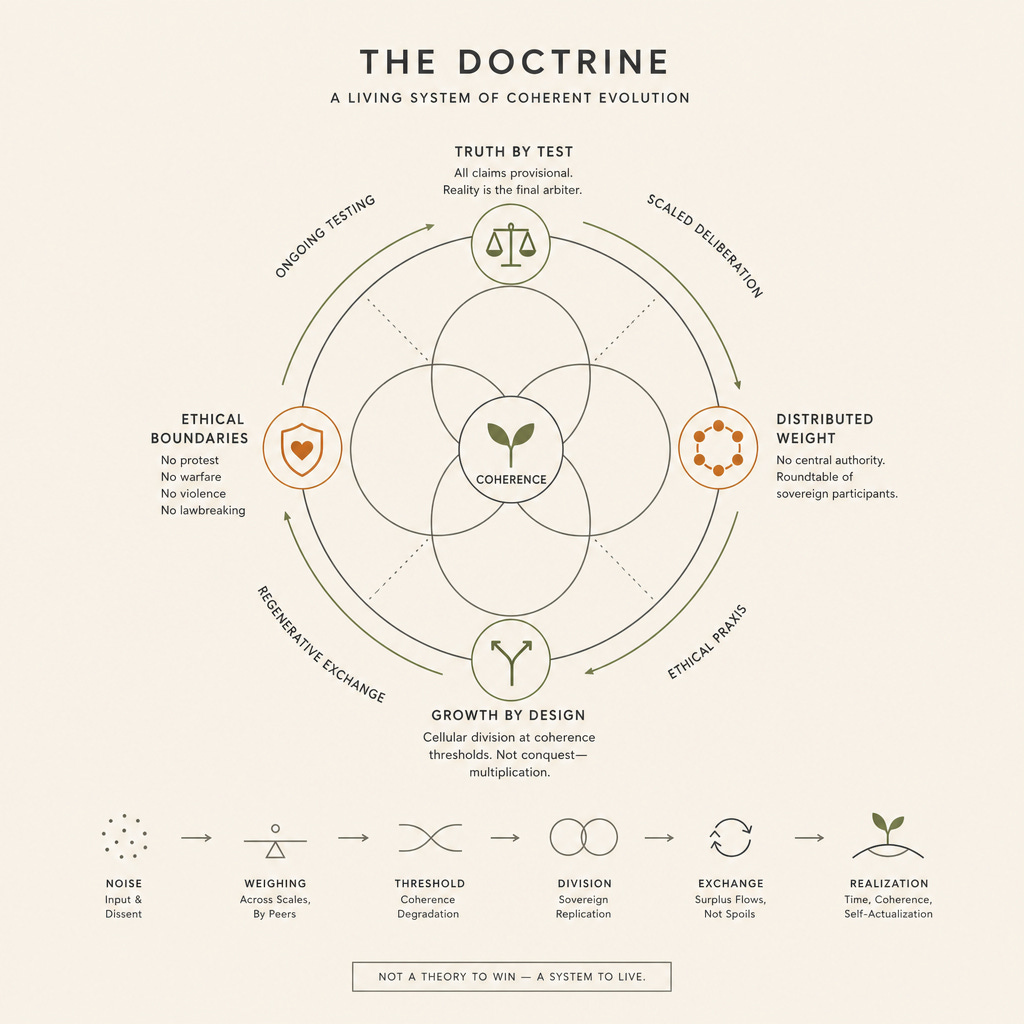
Preamble
This doctrine describes a proactive, self-organizing, emergent system by which individuals, families, and regions may practice self-governance — without protest, without warfare, without violence, and without breaking of laws. It does not seek to replace existing systems by force or argument. It seeks to out-compete them by being more coherent, more resilient, and more capable of returning time, connection, and self-realization to the people who build it.
It does not claim inevitability, authority, or monopoly. It claims only the right of those who recognize it as real and possible to build it.
I. Ontology — What Is Acknowledged
The doctrine rests on four ontological commitments, each a precondition for the others:
1. Acknowledgement of Sovereignty. Every individual, family, and nested group is recognized as a complete and self-directing unit — not a subordinate part awaiting authorization from a larger whole. Sovereignty here is not granted by the system; it is acknowledged as already and always present, in the same way every circle in a flower-of-life pattern is a complete circle, not a fragment of a larger one.
2. Recognition and Respect. Sovereignty acknowledged in the abstract means nothing without recognition in practice: each scale's right to self-determine its own internal process, pace, and participation is respected by every other scale, including larger ones. No tier "grants" this respect — it withholds interference as a standing default.
3. Responsiveness. Sovereignty and respect, without responsiveness, produce isolation rather than coherence. Every node remains genuinely open to signal arriving from other nodes — willing to be moved by what it encounters, not merely tolerant of its existence. Responsiveness is what keeps sovereign units in relationship rather than in parallel isolation.
4. Reciprocity. What is offered must be returned in kind for the system to remain non-extractive. Reciprocity is the ontological seed of the ~10% contribution floor: not tribute extracted upward, but value returned into the shared field at the minimum level required to keep the whole coherent. Where reciprocity breaks — where value flows one direction only — the system has, in that instance, reverted to the extractive pattern it exists to move beyond.
Together these four form a cycle, not a hierarchy: acknowledge → respect → respond → reciprocate → acknowledge again. Any doctrine, process, or structure that violates one of these at any scale has, in that instance, stopped being this doctrine.
II. Epistemology — How Truth Is Known and Tested
Ground and Figure. Every proposition rests on a ground — a logically articulated set of premises and reasoning, made transparent and observable to all. From that ground, a figure emerges: the proposition itself, the claim, the plan, the shift under consideration. The figure is never trusted because of who proposed it or how persuasively; it is trusted only insofar as its ground can be independently checked, tested, and strengthened by anyone willing to examine it.
Signal and Noise. Every figure exists somewhere on a continuum between two poles:
Signal-dominant: coherent, predictive of future outcomes, capable of being relied upon and built upon.
Noise-dominant: unreliable, unpredictive, incapable of sustaining further structure.
A proposition is never simply "accepted" or "rejected" — it is weighed, the way an individual mind weighs a mental construct against experience: provisionally held, tested against outcomes, revised or abandoned as evidence accumulates. The system's epistemology is the individual mind's epistemology, run at societal scale.
Noise as Steering, Not Opposition. Disagreement is not treated as a threat to a proposition's survival but as the input that steers it — noise identified is an opportunity for signal to be injected and the figure corrected. Coherence and incoherence function as the left and right of a steering wheel: both are necessary to keep the vehicle on the road. A proposition that receives no noise at all is not stronger for it — it is untested.
The Limit of This Epistemology. Ground-transparency solves the problem of hidden reasoning; it does not by itself solve the problem of uneven capacity to evaluate reasoning. The doctrine depends on continual widening of who can competently check a given ground — a live, working commitment, not a solved one.
III. Structure — How the System Is Shaped
Nested Scale. The system is organized in ascending, non-hierarchical tiers:
Individual → Family → Local Network of Families → Regional Network of Families → Region-to-Region Exchange
Each tier runs the same underlying pattern as every other — a roundtable of sovereign, opted-in participants — the way every circle in a flower-of-life pattern is generated by the same radius from a center. No tier contains authority over the tier below it; each tier is a complete instance of the pattern, not a subordinate fragment of a larger one.
The Contribution Floor. Each participant enters the regional economy with a minimum labor/value contribution — provisionally set as low as structurally possible, near 10% — calibrated so that regional supply reliably exceeds peak demand, freeing the majority of each person's time for relationship with self, others, the natural world, and self-realization. This floor is derived empirically, region by region, from real-world precedent (cooperative federations, commons-governance research, historical surplus economies) — never asserted from theory alone.
Region-to-Region Exchange. As individual regions generate durable surplus, that surplus becomes available for trade with neighboring regions — extending the zone of regenerative abundance outward, region by region, through voluntary federation rather than expansion by growth targets or evangelism.
Cellular Division, Not Cellular Monopoly. When a tier exceeds its coherent operating capacity, it does not stretch to absorb the excess, and it is not replaced or absorbed by something larger. It divides — producing two fully sovereign, fully capable daughter nodes, each carrying the complete pattern, neither subordinate to the other or to the node that preceded them. Growth is accommodated by multiplication of coherent units, not by expansion of any single unit past its coherent limit.
IV. Process — How Decisions and Change Occur
1. Proposition Scoring. Every proposition entering the system begins at a neutral midpoint on a continuum from -50 (noise-dominant) to +50 (signal-dominant). As separate groups, at various scales, weigh in on it, the score moves toward one pole or the other based on whether the proposition proves coherent, predictive, and reliable — or not.
2. Distributed Weighing. No central authority computes this score. It is measured by the roundtable republic of member nodes itself — the same distributed structure the doctrine describes everywhere else, applied recursively to its own self-assessment.
3. The Tournament of Will and Opinion. Dissent ("no") at any given scale registers as a noise contribution to the proposition's score — one vote among peers, never a unilateral veto. No single scale can freeze the system's ability to respond to its own coherence. The proposition advances through accumulated signal dominance, never through any tier's ability to stall or stagnate the process.
4. The Division Checkpoint. When accumulated noise on the question of a tier's own coherence crosses a threshold, the cascading vote propagates upward through the scales until the broadest relevant tier confirms: this is the moment of cellular division, not cellular monopoly. The trigger is measured coherence degradation — not headcount, not a calendar, not central decree.
5. Ongoing Testing. No proposition, once signal-dominant, is permanently settled. It remains subject to continual re-weighing as new noise or signal is identified — the same way a reliable belief remains open to revision by an individual mind encountering new evidence.
V. Praxis — The Ethical Boundary Conditions
The entire process above operates within four hard constraints, none of which are negotiable regardless of provocation, delay, or apparent advantage:
No protest — the system does not organize against existing structures; it organizes independently of them.
No warfare — conflict with incumbent systems is never sought or accepted as a method.
No violence — coercive force is excluded categorically, in keeping with the doctrine's founding critique of implicit-consent coercion.
No breaking of laws — the system builds entirely within existing legal space, the way Mondragón built worker ownership inside corporate law rather than against it.
The doctrine wins, if it wins, by being chosen — region by region, family by family — because it demonstrably returns more coherence, time, and self-realization than the systems it stands beside. It does not need those systems to fall. It only needs to be real enough, and good enough, that people who encounter it recognize it as more possible than what they were told was inevitable.
Closing Statement
This doctrine is not a claim that the current order is finished. It is a claim that another order can be built, quietly, lawfully, and voluntarily, beside it — structured so that its own growth cannot become the very thing it was built to move beyond. Its test is not whether it can win an argument. Its test is whether it can be lived.